
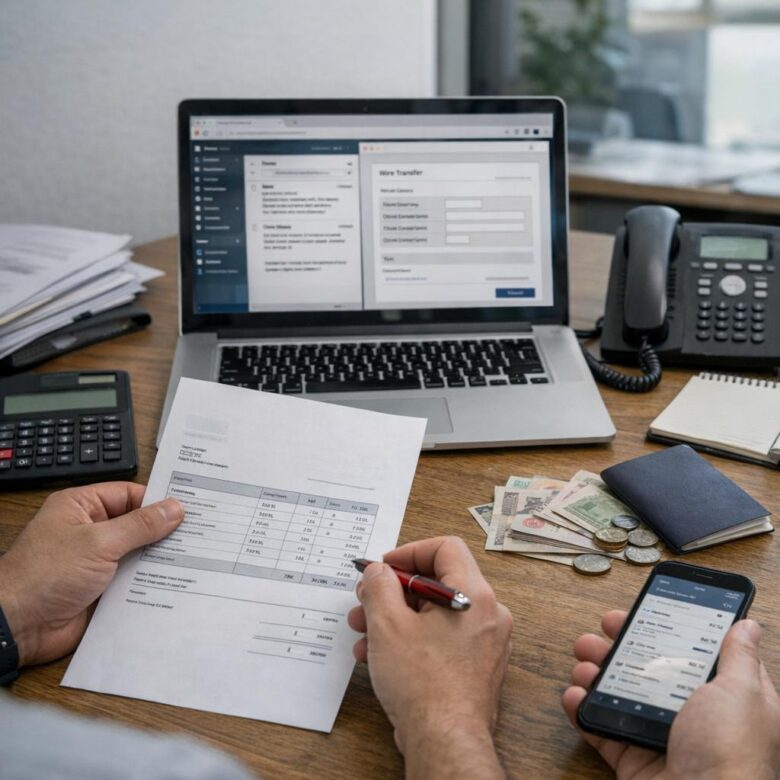
What if a “routine” bank detail change was the most expensive email your finance team ever approved?
Invoice fraud thrives in moments of trust, urgency, and cross-border complexity-especially when overseas vendors request changes to payment details.
Different time zones, language barriers, unfamiliar banking formats, and pressure to avoid payment delays can all weaken verification controls at the exact point fraudsters strike.
This article explains how to reduce the risk of fraudulent vendor detail changes, strengthen approval workflows, and protect international payments before money leaves your account.
Why Overseas Vendor Detail Changes Are a Prime Invoice Fraud Risk
Overseas vendor detail changes are high-risk because they often involve different time zones, unfamiliar banking formats, currency conversions, and slower communication. Fraudsters exploit these gaps by sending convincing emails that request updates to bank account details, payment terms, tax information, or remittance instructions just before an invoice is due.
In practice, this is where many accounts payable teams get exposed. For example, a supplier in Singapore may appear to email a new beneficiary account for a USD payment, but the message actually comes from a compromised mailbox or a lookalike domain with one changed letter.
The risk increases when companies rely only on email approval instead of using vendor verification services, supplier portals, or ERP controls. Platforms such as SAP Ariba, Coupa, and Oracle NetSuite can help by creating approval workflows, audit trails, and segregation of duties before any payment information is changed.
- Bank account changes should be verified through a known phone number, not the contact details in the request.
- New overseas beneficiaries should trigger enhanced due diligence, sanctions screening, and tax documentation checks.
- Urgent payment requests should be treated as a red flag, especially when paired with confidentiality or pressure.
A useful real-world control is a “call-back and hold” policy: verify the change independently, then delay the first payment to the new account until a second approver reviews it. It may add a day to the payment cycle, but the cost is minor compared with recovering funds from an international wire transfer fraud case.
How to Verify International Supplier Bank Account Changes Before Payment
Any request to change overseas vendor bank details should be treated as a high-risk payment event, not a routine admin update. Before releasing funds, your accounts payable team should verify the change through a separate communication channel, such as calling a known supplier contact using the phone number already stored in your vendor master file, not the number shown on the new invoice.
A practical workflow is to pause the payment, validate the bank data, and document every approval step. For international payments, check the IBAN, SWIFT/BIC code, beneficiary name, bank country, and currency against the original supplier onboarding records and contract terms.
- Use an IBAN and SWIFT validation service before adding the new account.
- Require dual approval from finance and procurement for vendor master data changes.
- Screen the beneficiary and bank through compliance tools such as Refinitiv World-Check or your banking portal.
For example, a manufacturer receiving a “new bank account” email from a long-term supplier in Germany should not rely on the email thread alone, even if it looks genuine. A quick call to the supplier’s finance manager using the existing contact record may reveal that the mailbox was compromised and the invoice was altered.
In larger teams, vendor management platforms such as SAP Ariba, Coupa, or NetSuite can help by creating audit trails, approval workflows, and payment fraud prevention controls. The small cost of verification is usually far lower than the cost of recovering an international wire transfer after it has reached a fraudulent account.
Common Control Failures That Let Vendor Detail Fraud Bypass Accounts Payable
Vendor detail fraud usually slips through because the change process is treated as admin work, not a financial control. In practice, I often see overseas supplier bank updates approved from a forwarded email, especially when the message appears to come from a known contact and mentions an urgent shipment, overdue invoice, or currency issue.
The biggest weakness is relying on email as proof. A fraudster may compromise a vendor mailbox, request a new beneficiary account, and attach a legitimate-looking invoice with updated payment instructions. If accounts payable updates the ERP without independent verification, the next international wire transfer can go to a mule account.
- No call-back control: AP staff confirm changes by replying to the same email instead of calling a verified phone number from the vendor master file.
- Weak segregation of duties: One person can edit bank details and release payment in systems like SAP Ariba, Oracle NetSuite, or Microsoft Dynamics 365.
- Poor audit trails: Vendor master data changes are not reviewed against invoice payment runs, SWIFT details, or beneficiary name mismatches.
A real-world example is a manufacturer paying an Asian freight supplier after receiving “new banking details” due to a supposed compliance update. The invoice was genuine, but the bank account was not. A simple vendor verification workflow using Tipalti, Coupa, or bank account validation services could have flagged the mismatch before payment approval.
Strong controls do not have to slow operations. The practical fix is dual approval for vendor changes, documented call-back verification, automated risk scoring, and a payment hold period for high-value or first-time overseas bank account updates.
Wrapping Up: Mitigating the Risk of Invoice Fraud When Changing Overseas Vendor Details Insights
Invoice fraud thrives when urgency overrides verification. The safest approach is to treat every overseas vendor detail change as a controlled financial risk, not a routine admin update.
Practical takeaway: no payment details should be amended or used until they are independently verified through trusted, pre-existing channels and approved by the right internal authority.
Businesses should invest in clear procedures, staff training, dual approvals, and audit trails. If there is any doubt, pause the payment. A short delay is far less costly than recovering funds after they have reached a fraudulent overseas account.

The Yiptung Trade Editorial Team creates practical, research-based content about Asian supply chains, cross-border B2B payments, import and export compliance, supplier management, international logistics, and trade risk. Our articles are reviewed using official regulatory, customs, banking, and industry sources whenever possible. Yiptung Trade provides educational information and does not replace advice from licensed customs brokers, attorneys, tax professionals, or financial compliance specialists.